Osso Buco literally translates to “bone with a hole.” The dish centers around a cross-cut veal shank, where the marrow is as much a part of the sauce as the meat itself. In this long-form exploration, we analyze the Maillard-to-Gelatin transition and the traditional pairing with Risotto alla Milanese, a dish that uses beef marrow as its primary fat source to create a “echo” of flavor.
The Earth Oven Alchemy: Mastering Ancestral Barbacoa de Borrego
Authentic Barbacoa is a lesson in patience and the transformative power of indirect heat. While the meat is the star, the process is dual-purpose: as the lamb roasts in an underground pit (el horno), its juices drip into a pot of chickpeas and chilies below, creating a legendary broth known as Consomé. This guide deconstructs the “Pit-to-Plate” mechanics, focusing on the essential role of the Penca de Maguey (Agave leaf).
The Underground Alchemy: Deciphering the Cochinita Pibil
Cochinita Pibil is a pre-Hispanic masterpiece that defies the “taco” stereotypes. It is not about heat; it is about the interplay between the earthy bitterness of Achiote (annatto), the floral acidity of Sour Orange, and the smoky perfume of Banana Leaves. Traditionally cooked in a Pib (an underground earth oven), this guide shows you how to replicate that “buried” intensity in a modern kitchen.
The Art of the Melt: A Deep Dive into Buta no Kakuni
If sushi represents Japanese precision, Buta no Kakuni represents Japanese comfort. This is “stewed pork” taken to its logical conclusion: squares of belly meat simmered until they can be cut with a dull chopstick. It’s a dish defined by the balance of sweet mirin, savory soy, and the sharp bite of hot mustard (Karashi).
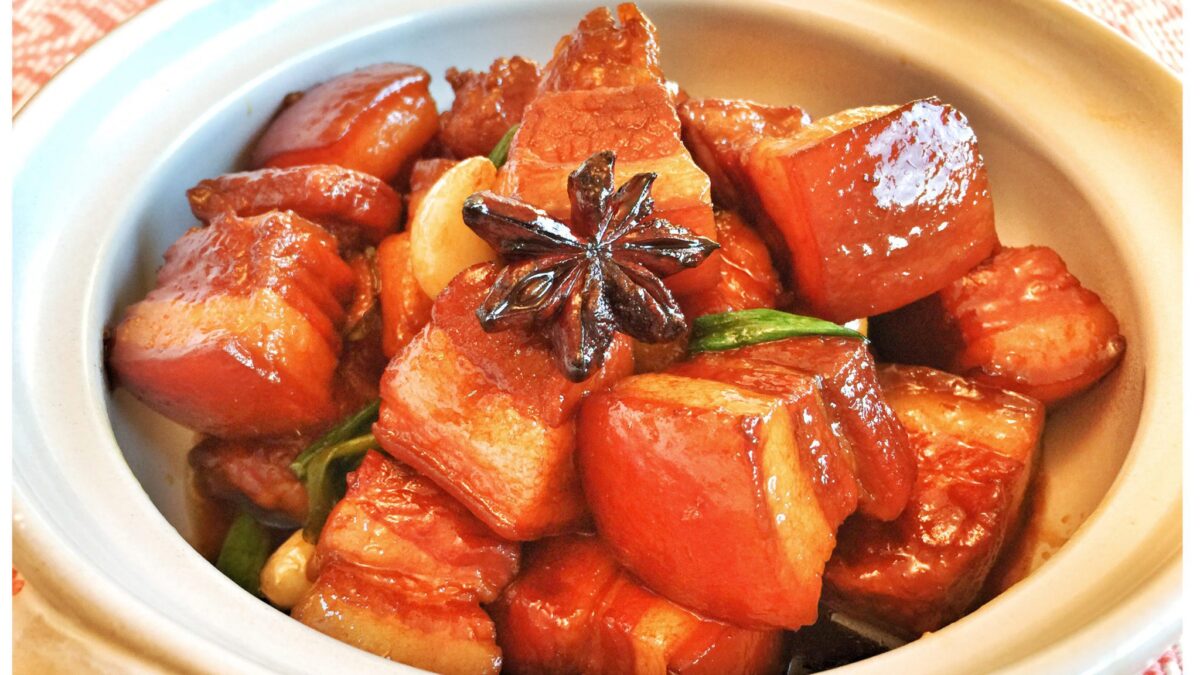
The Philosophy of Red Braising: Mastering the Perfect “Hong Shao Rou”
Red braising (Hong Shao) is more than a cooking method; it is a cultural obsession. A perfect Red Braised Pork Belly should be mahogany in color, trembling to the touch, and so tender that the fat melts into a buttery glaze while the lean meat remains succulent. This guide moves away from shortcuts, focusing on the traditional “Sugar-Coloring” (Chao Tang Se) technique and the art of slow-reduction.
The Imam Fainted: Authentic Turkish İmambayıldı (Stuffed Eggplants)
İmambayıldı is a masterpiece of Ottoman vegetarian cooking. It features tender, melt-in-your-mouth eggplants stuffed with a rich, aromatic mixture of onions, garlic, and tomatoes, all slowly braised in high-quality olive oil. The dish is a testament to how humble ingredients—when treated with patience and technique—can create a flavor profile worthy of a sultan.
The Sultan’s Delight: Hünkar Beğendi (Smoky Eggplant Purée with Braised Lamb)
Legend has it that this dish was created for the French Empress Eugénie during her visit to the Ottoman Sultan’s court in the 19th century. Hünkar Beğendi literally translates to “The Sultan Liked It.” It features a velvety bed of fire-roasted eggplant and aged cheese topped with a slow-cooked, tomato-based lamb ragout.
The Art of Slow Cooking: Authentic French Coq au Vin
Summary: Master the quintessential French farmhouse classic. Coq au Vin is a rich, velvety red wine braise featuring tender chicken, smoky lardons, and earthy mushrooms. This guide breaks down the traditional “low and slow” technique to achieve a restaurant-quality sauce and fall-off-the-bone texture.